The Internet's Quietest Obsession: Why No-Talking Build Videos Are America's New Bedtime Ritual
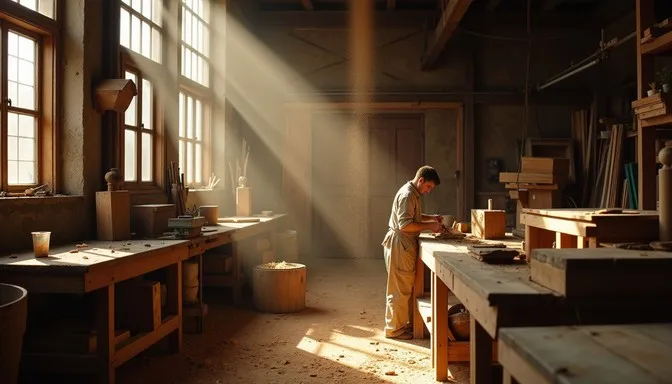
Photo: person woodworking alone in quiet workshop warm light, via images.stockcake.com
Somewhere in America right now, a nurse coming off a night shift is watching a man in Japan plane a board for eleven minutes. No music. No talking. Just the hiss of the blade and the slow reveal of a curl of wood. She's not learning woodworking. She's not going to build anything. She's just... breathing easier.
If you've spent any time on the crafting side of YouTube or the maker corners of other platforms, you know exactly the content I mean. The no-talking build. The time-lapse joinery. The six-hour workshop vlog where the biggest drama is a glue-up that goes slightly sideways. Call it process content, call it slow TV for the algorithm age — whatever the label, it has quietly become one of the most reliably watched genres on the internet, and the reasons why say a lot about how worn-out we all are.
The Arc Is the Comfort
Most entertainment runs on tension. Will they or won't they. Who's the killer. What's the twist. Process content runs on something else entirely: a guaranteed arc. A pile of rough lumber becomes a table. A sketch becomes a cabinet. Nobody's going to betray anybody. The board is not going to file a lawsuit.
There's real psychological weight in that predictability. Researchers who study "slow TV" — the Norwegian genre that gave us a seven-hour train ride broadcast live — point to its low cognitive load as the draw. Your brain knows the shape of what's coming, so it can relax into it. It's the same reason we rewatch sitcoms we've seen a dozen times. The ending is safe, and safe is the whole point.
Parasocial Comfort, Minus the Conversation
There's also a person in the frame, and that matters more than viewers usually admit. Watch a maker's channel long enough and you learn their laugh, their dog's name, the way they mutter "that's not going anywhere" after every glue-up. It's a parasocial relationship — a one-sided bond, sure, but a genuinely soothing one.
For a lot of Americans, especially those working hybrid schedules or living far from family, that background-presence familiarity fills a gap. The creator never asks you anything. They never need a favor. They just work in the next room, so to speak, and you keep them company. In an era where social media increasingly feels like an argument you didn't agree to attend, a guy sanding a drawer front in silence is a form of mercy.
What This Means for Creators
Here's the part the creator economy folks should sit up for: process content is one of the few genres where less production often means more loyalty. The fixed-camera, no-voiceover format is cheap to make, endlessly watchable, and ages beautifully — a build video from five years ago hits exactly the same as one uploaded yesterday. Evergreen by design.
It also monetizes in unusual ways. Watch time on these videos is extraordinarily long, with viewers using them as sleep aids and work-session background noise. That watch time is gold for ad revenue, and the calm-adjacent audience skews toward buying tools, materials, and courses — a natural funnel for creators who sell plans or gear.
The tradeoff is intimacy over scale. This genre doesn't produce viral explosions; it produces decades-long relationships with an audience that shows up every Sunday night with a cup of chamomile.
The Deeper Appeal
Zoom out and the phenomenon makes perfect sense. We spend our days in jobs where nothing is ever finished — the inbox refills, the notifications never stop, the project ships and immediately needs version two. Process content offers the one thing modern American life rarely does: a task with a visible beginning, middle, and end, completed by human hands, in real or near-real time.
We watch people build things because, for forty minutes, something in the world gets finished. And honestly? That might be the most entertaining thing on the internet right now.