Shop Night, But Make It Digital: The Livestream Build Is the New Hangout
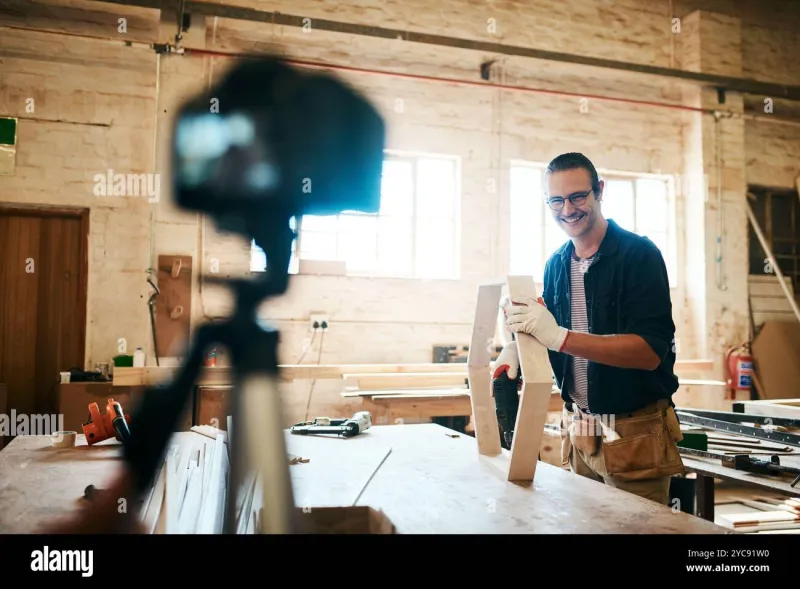
Photo: woodworker livestreaming workshop garage camera setup, via c8.alamy.com
There's a particular sound that fills a livestreamed workshop that you'll never hear in an edited video: nothing. The saw stops. The room goes quiet except for the shop vac humming somewhere off-mic. And in the chat, 400 people hold their breath waiting to see if the pocket-hole screws line up.
This is shop night in 2025, and it's not happening at your neighbor's house. It's happening live, from a two-car garage in Ohio, to an audience that might as well be sitting on sawhorses around the perimeter of the shop.
The Build Video, But Unedited
For a decade, the maker content economy ran on compression. Fourteen hours of work, cut down to 18 minutes, set to music, color graded to look like a magazine spread. It's beautiful. It's also a finished product about finished products.
Livestreams throw all of that out. A streamer might spend four hours on a single cabinet face. Viewers watch glue set. They watch a guy stare at a board for a full minute deciding which edge to joint first. And weirdly, they don't leave.
The appeal isn't efficiency — it's proximity. When you watch an edited video, you're being shown a result. When you watch a live build, you're in the room. The mistakes happen in real time. The improvisation is real. When the track saw blade guards up mid-cut and the streamer mutters something the FCC wouldn't love, that's not a blooper. That's Tuesday.
Chat Is the Second Workshop
The most underrated feature of a maker stream is the sidebar. Because the build is slow, the chat is fast. Someone in Tucson asks how to keep plywood from tear-out. Someone else answers before the streamer even sees the question. A third person posts a photo of the jig they built last weekend. By hour two, the chat has solved three problems the creator never mentioned.
Creators who do this well treat the stream less like a broadcast and more like a hosted shop night. They read names out loud. They circle back to questions from 45 minutes ago. They'll pause mid-glue-up to explain why they're using cauls on the panel — not because it makes good content, but because someone asked and they'd rather answer now than later.
It's the difference between a lecture and a conversation. And for a hobby that's overwhelmingly practiced alone in garages and basements, that distinction matters more than any camera upgrade.
The People Who Show Up at 3 A.M.
Here's where it gets interesting: the schedules are strange, and the audiences don't care. Night-shift nurses watching on their lunch break. Insomniacs in Boise. New dads pacing with a baby in one arm, phone in the other, watching a mortise and tenon come together at 2:40 in the morning.
For these viewers, the stream isn't appointment viewing in the old TV sense — it's more like a porch light left on. You wander in when you wander in. The stream is just there, live and warm, and somebody is building something.
Some creators have leaned into this hard. They run streams with no talking at all, just the ambient sound of hand planes and the chat scrolling in silence. Others go full open-mic, taking questions the entire time and pulling up viewer projects on a second monitor. There's no single formula. The common thread is that the audience isn't a number on a dashboard — it's a regular crowd.
Why This Format Is Harder Than It Looks
Talk to anyone who's done it, and they'll tell you live is a different job. There's no editor to save you. A dead-air moment on stream is genuinely dead. The tech stack — stream encoder, mic levels, lighting that survives a garage at night — is one blown breaker away from chaos. And unlike an edited video, a live stream can't be trimmed to hide the hour where nothing went right.
But that fragility is exactly the product. Viewers stick around because anything could happen, including nothing. The streamer who can hold an audience through a slow glue-up isn't just entertaining — they're demonstrating a kind of confidence that edited content can't fake.
The Return of Watching Together
Streaming platforms spent twenty years teaching us to watch alone, on our own schedules, with our own queues. Livestreamed builds quietly reverse that. Thousands of people, all watching the same board at the same moment, talking about it while it happens.
It's not nostalgia, exactly. It's something older than television and newer than YouTube: people gathering around someone making something with their hands. The garage just happens to have a camera in it now.
If you've been building alone and wondering whether anyone else cares about your rabbit-toothed tenons — find a stream, drop into the chat, and say hi. There's almost always room at the bench.