Glue Doesn't Judge: Inside the Woodshop's Unofficial Therapy Sessions
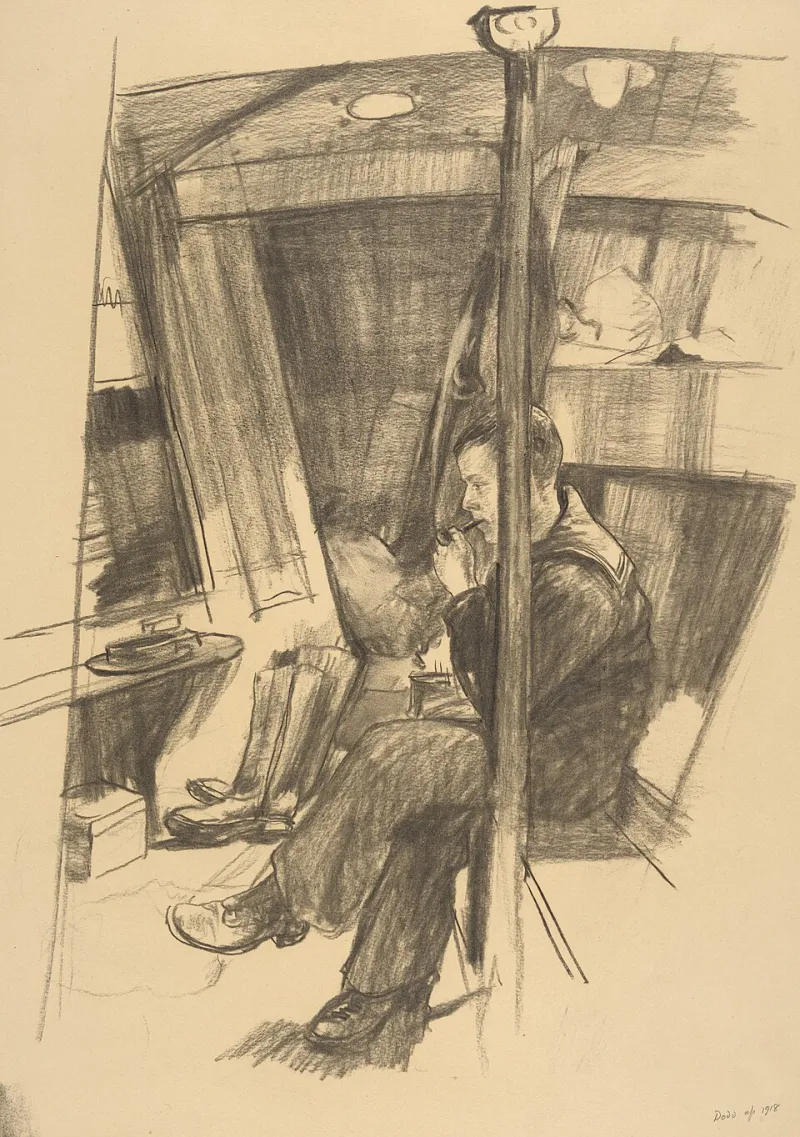
Photo: Francis Dodd, Public domain, via Wikimedia Commons
There's a moment that happens on a lot of build channels that has nothing to do with woodworking. The router's humming, the glue's setting, and the host — mid-sentence, no music cue, no dramatic thumbnail bait — mentions that he and his wife finalized things in March. Then he feathers a chamfer and moves on.
If you've spent any time watching American maker content, you've seen it. The shop cam catches things a living room never would. And according to the creators themselves, that's not an accident. It's physics. Or at least it feels like it.
The Loneliest Room in the House
Ask most builders why they talk to the camera like an old friend and they'll give you a version of the same answer: the shop is where they're alone for six, eight, twelve hours a day.
"When you're filming a ten-hour build, you run out of things to say about dadoes around hour two," one mid-sized channel creator told us, requesting we keep it anonymous so his in-laws don't discover the episode where he discussed his job loss. "The camera becomes the guy standing next to you. You start telling it stuff."
There's a name for this effect among podcasters and long-haul streamers: parasocial bleed. The audience isn't a crowd — it's one familiar presence, always there, never interrupting. And unlike a spouse or a buddy from church, the camera can't be disappointed in you.
Why the Confession Works On Camera
There's a structural reason shop confessions land differently than, say, a talking-head vlog. In a vlog, the story is the content. In a build video, the story is incidental — riding shotgun next to the actual work. That gives the speaker plausible deniability. They can drop something heavy, then hide inside a rip cut before it gets too uncomfortable.
Viewers notice. Comments under these videos read less like fan mail and more like the reply column of an advice podcast: "Needed this today, brother." "Going through the same thing. Thanks for saying it out loud."
A few creators have leaned in deliberately, structuring entire videos around a hard conversation held while they work. Others insist it's never planned. The truth, based on our conversations, sits in the middle: the first confession is usually accidental. Everything after gets easier.
What the Audience Gets Out of Eavesdropping
There's a long-standing theory among creators that build videos function as ambient company — the digital equivalent of a neighbor working in his garage while you lean on the fence. The personal disclosures are part of that. They signal that the person on screen is a whole human, not a brand.
But there's something else, too. A lot of the audience for these channels is men between 35 and 65 — a demographic not exactly famous for processing feelings out loud, even in 2025. Watching a guy in Georgia talk about therapy while flattening a slab does a kind of cultural work that no PSA could. It gives permission.
"I've had guys email me saying they started counseling because of a video where I mentioned it offhand," one creator told us. "I was sanding. I wasn't even looking at the camera."
The Business Side of Being Real
Of course, this is still the Creator Economy, and vulnerability has a complicated relationship with the algorithm. Creators told us that deeply personal videos often perform modestly on day one, then quietly accumulate views for years — evergreen search traffic from people looking for exactly that honesty. Others admitted that once you've had one viral confession, there's a pull to manufacture the next one, and that audiences can smell the difference.
The healthiest channels, it seems, treat disclosure like a rare hardwood: use it sparingly, never fake it, and let the grain show. Nobody wants a sponsor-read followed by a divorce announcement in the same breath. The pacing matters. The trust matters.
The Workbench Stays Open
The phrase that came up again and again in our interviews was some version of "the shop doesn't judge." Not the audience, not the tools, not the pile of failed jigs in the corner. For a lot of builders, the shop is the one room where the version of themselves they present to the world and the version that actually exists get to overlap for a while.
The camera just happens to be in the room when it does.
So the next time you click on a video about a farmhouse table and end up hearing about somebody's custody arrangement, don't reach for the skip button. That's not the content going off the rails. That's the reason you're watching at all.